


When Ellie Tyler joined AdCellerant as their first Technical Project Manager, the company was doing what every scaling startup does: outgrowing the scrappy coordination that got them this far.
With about 30 engineers across three teams, nothing was technically broken. Product managers were sharp at defining features, engineers were shipping consistently, and the company was growing. But gaps were appearing between what leadership could see and what was actually happening.
Swarmia gave Ellie and leadership the engineering insights they needed to balance feature delivery with foundational work — without requiring engineers to change how they work.
The work that doesn’t make it onto the roadmap
In Ellie’s first few months, a lot of her time was spent manually figuring out where all the engineering work was going. She knew senior developers were doing more work than appeared on any board.
Senior engineers were doing critical foundational work — refactoring, infrastructure improvements, covering for teammates — but because this work didn’t always have formal tickets or make it into sprint planning, leadership couldn’t see it.
Story points were creating problems too. Different teams interpreted them differently. Six features all estimated the same number of story points, but one took two weeks and another took two months. They were also being used for just about everything — quarterly planning, software capitalization, capacity forecasting — even though story points weren’t designed to answer “how long will this take?“ or “where did the time go?“
We were excited by Swarmia because even early on, just seeing all the engineering data in one place — including the foundational work that doesn’t always make it onto the roadmap — gave us the clarity we needed. Everything else was icing on the cake.

Technical Project Manager at AdCellerant
Initiatives put the data behind the vibes
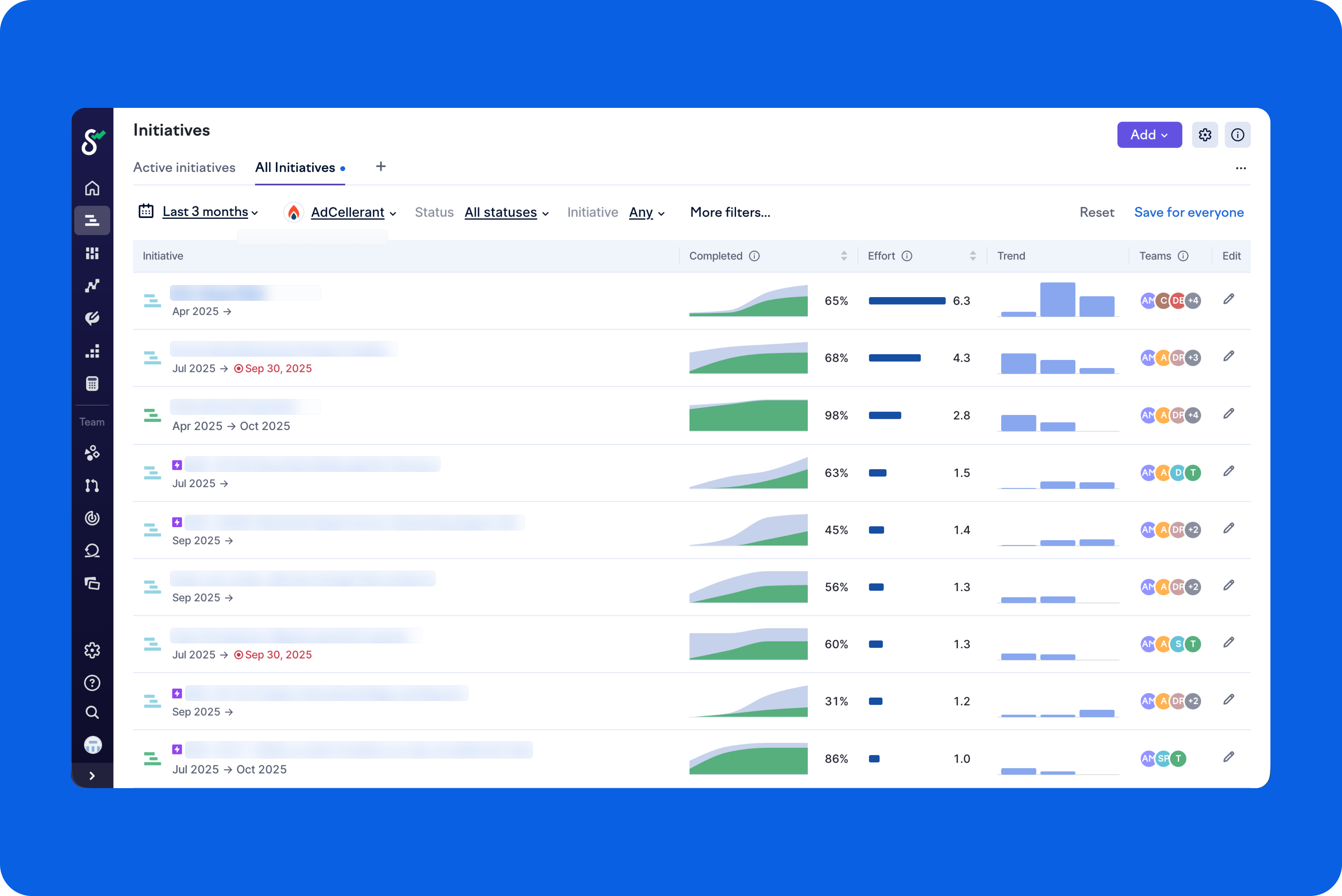
Today, Ellie manages quarterly planning using Swarmia initiatives alongside a tracking spreadsheet. Each major feature or project is automatically imported from Jira into Swarmia. The initiative forecasting capability has totally changed how conversations around delivery happen.
For each initiative, Ellie uses the forecast feature to set expectations with leadership. She sets the story cycle time based on their team’s working agreements — typically 14 days. She estimates throughput based on how many stories the team typically completes. Then Swarmia shows the projected completion date.
When leadership asks, “What happens if we add another developer?“ Ellie can adjust the forecast and show them immediately. When they want to know if a faster-moving team could deliver sooner, she can model that scenario too.
When leadership asks when a project will be completed, I can use Swarmia initiatives to show them the forecast and answer with confidence.
Technical Project Manager at AdCellerant
The initiatives overview gives Ellie and leadership a single view of everything in flight. They can see which initiatives are progressing steadily, which ones are winding down, and where scope might be expanding.
Making engineering legible to non-technical folk
Every other week, AdCellerant holds an executive sprint review. Engineering, product, and executive leadership get together to answer questions like “Are we hitting our goals?“ and “Are we running into cross-departmental issues?“
Product managers handle these conversations easily. They’re used to translating their work for executives. For engineering, there’s the tendency to jump into technical details that make perfect sense to engineers and not much to anyone else.
For that meeting, Ellie leans heavily on Swarmia’s focus summary.
The executive has the visibility to ask, ’Swarmia shows that we spent more time than usual on bug fixing this sprint, where are they coming from?’ and I have the power to drill down into the data on the spot.
Technical Project Manager at AdCellerant
This view gives executives the information they need to make informed trade-offs. They can see the time being spent on bugs and decide: “I’m willing to deal with more support tickets later if this feature ships now.“ Or the opposite: “This feature can wait — make sure we fix these bugs so our customers stay happy.“
The conversation becomes about work items, not people. Not “person X spent this much time on this,“ but “here’s where engineering effort went this sprint.“ Nobody gets defensive, and nobody has to explain themselves. The data is just there, ready to be used.
Product managers were initially hesitant about sharing Swarmia with the broader company. Too technical, they thought. Too confusing for non-engineering stakeholders. But the focus summary proved surprisingly easy for everyone to understand. As long as initiatives have clear, concise titles, the whole business can see where engineering time is going.
Standups became useful again
Standups at AdCellerant used to go one of two ways: status updates that nobody really needed to hear, or there wasn’t much to say. Early morning meetings where people hadn’t had time to process their work yet, or were worried about how bringing up a problem might come across.
Working agreements changed that. Instead of going through every story in progress, Ellie started to focus standups on the stories that are above their agreed limits. And after some time, other dev leads on Ellie’s team ended up taking ownership and now run the standups independently.
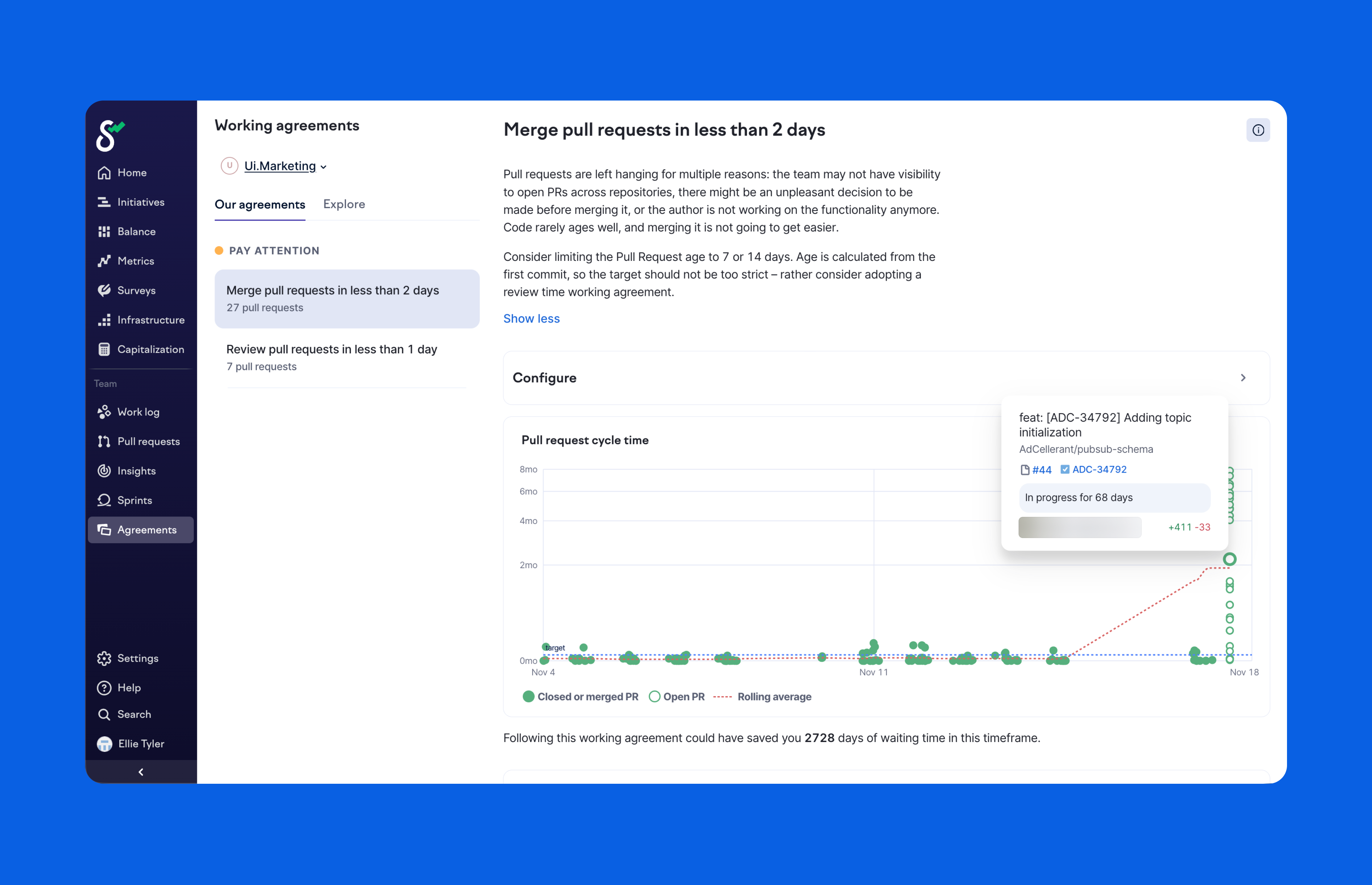
For developers, the most impactful changes have come from working agreements. They’ve turned standups from a status update to an actual conversation about where work is stuck, and how we can help.
Technical Project Manager at AdCellerant
Reclaiming a week every month
Software capitalization at AdCellerant has been eating a week of Ellie’s time, every single month.
Each month goes something like this: export all the stories developers worked on, export the story points, export the software capitalization categories. Create about eight pivot charts. Clean up the missing data. Fix formulas that break when copied between months. And repeat.
Getting Swarmia’s software capitalization into use is on Ellie’s Q1 2026 goal list, and she’s counting down the days until she can retire her old spreadsheet for good.
Software capitalization takes a week of my month — exporting data, building pivot charts, cleaning up what developers understandably forgot to track. Automating this with Swarmia means I get that time back to actually help teams estimate and deliver better.
Technical Project Manager at AdCellerant
Finance wanted this year to stay consistent for auditors, which makes sense. But starting in January, she’ll run both reports in parallel — the manual one they’re used to, and the new automated one from Swarmia. After a few months of showing that Swarmia data is more accurate and reliable than spreadsheets or time tracking, she’ll make the switch.
What changed for AdCellerant
Since adopting Swarmia, the biggest changes have been around how teams communicate and make decisions:
- Engineering standups got more useful, because working agreements in Swarmia give teams data to start conversations.
- Leadership meetings got clearer, now that the focus summary makes engineering work visible and understandable. Executives can see where engineering effort is going and make informed decisions about priorities and trade-offs.
- Quarterly planning got more realistic, since Ellie can show leadership what’s actually achievable based on team velocity and capacity, rather than optimistic estimates.
At nine in the morning with so many people around, it’s hard for some developers to step up and say: “This is way bigger than I thought. I need to reevaluate.” But having the data visible in Swarmia makes it easier for people to jump in and help out.
Technical Project Manager at AdCellerant
And finally, the manual work that used to consume Ellie’s time — tracking down where hours went, compiling capitalization reports, translating engineering work for executives — is becoming more and more automated. The time she saves goes toward helping teams estimate better, communicate effectively, and deliver predictably.

