


Last year, Sebastian Schleicher did something that would make most CTOs nervous: he removed the engineering manager layer at Blinkist entirely.
Today, all 30 engineers report directly to him and his Director of Engineering Operations, in what he calls an IC-led engineering organization. Individual contributors drive decisions, own their domains, and organize into temporary teams around “missions” that last 6-12 months.
But this model only works with the right automation layer — in their case, Swarmia.
Proving engineering wasn’t slow
This isn’t Blinkist’s first time using Swarmia. Years earlier, when they still had a traditional org structure, Sebastian adopted Swarmia to solve a problem that was growing rather frustrating: leadership thought engineering was slow, and he had no way to prove otherwise.
Sebastian knew his teams were moving quickly, but all the work — pull requests, code reviews, bug fixes, and infrastructure improvements — remained hidden from stakeholders, who only saw the finished features.
After connecting Swarmia, Sebastian discovered that Blinkist already ranked in the top 10% for cycle time. This wasn’t the problem. The work log revealed the actual bottlenecks: engineers were context-switching, working on too many things at once, and getting pulled into unplanned work that never made it onto anyone’s roadmap.
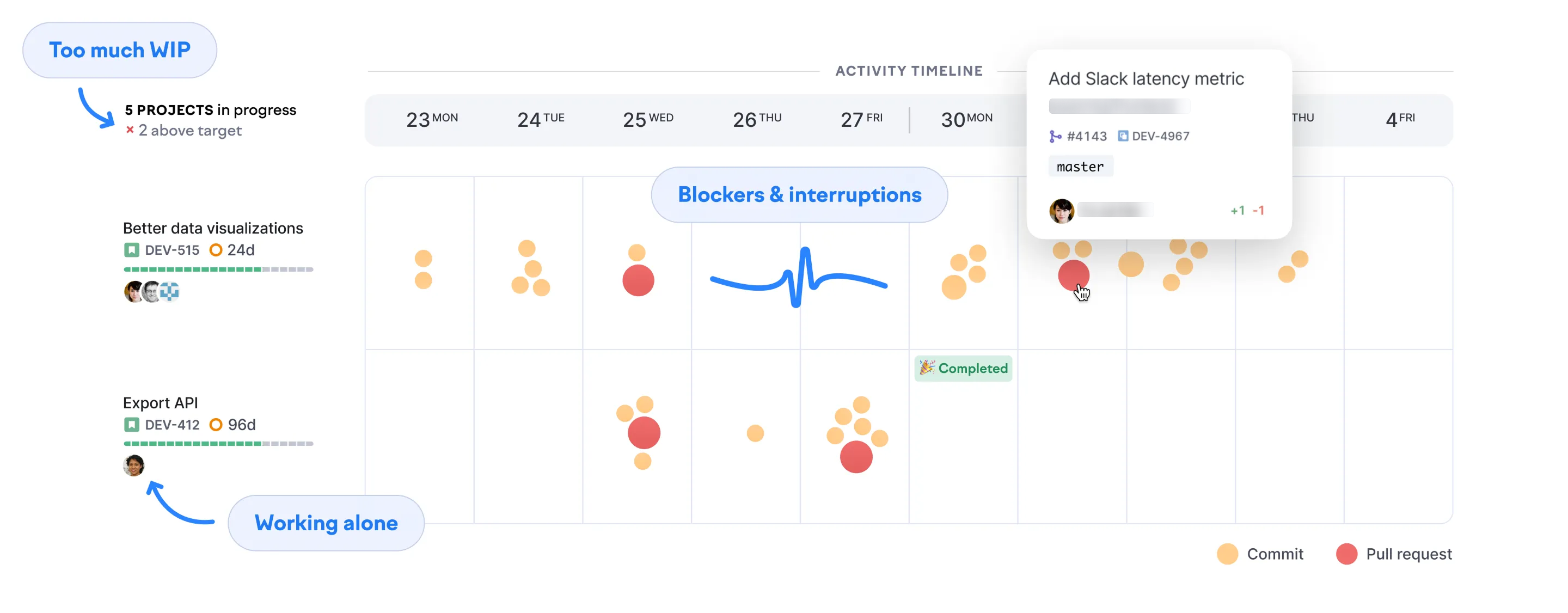
Without engineering managers, we need a tool that creates visibility. Swarmia effectively automates the project-management side of the engineering manager role.

CTO at Blinkist
Armed with this data, Sebastian could finally steer the conversation away from “engineering is slow” toward the systemic issues that actually needed attention.
A bonus win came after enabling Swarmia’s Slack integration: they were shipping faster without anyone explicitly trying to change anything. Engineers simply became more aware of their work patterns, grew curious about bottlenecks, and naturally started addressing them.
Their first chapter with Swarmia came to an end when budget cuts forced difficult decisions. But the lessons about visibility stuck with Sebastian — and would prove crucial for what came next.
The bold organizational move
The decision to remove engineering manager roles came about after observing patterns that weren’t working.
Engineering managers struggled to define their roles clearly, and communication paths had become unnecessarily complex — when developers on different teams needed to collaborate, conversations were routed through multiple management layers instead of happening directly.
Sebastian realized something important: the engineers themselves had the deep business and technical knowledge needed to run the engineering organization. Staff and senior developers were already driving the missions, while product managers handled product direction.
What remained — operational visibility and centralized people management — could be handled differently.
We matured away from a need for engineering managers. The engineers themselves knew way more about the business and technology — the only thing missing was working together across boundaries.
CTO at Blinkist
The solution is rather unique: all engineers now report directly to Sebastian, supported by a Director of Engineering Operations who handles career development, feedback, hiring, and operational processes. This role centralizes the people management function that was previously distributed across multiple people.
Making IC-led engineering work
Without engineering managers, Swarmia went from being a nice-to-have tool into essential infrastructure.
Sebastian’s goal was, again, clear: automate the observability of engineering work so he wouldn’t need someone to manually assemble progress updates in digital whiteboards or spreadsheets. In Swarmia, that information is readily available and easily visible.
But visibility only works if the data is reliable. With 30 engineers reporting to him, Sebastian can’t afford to make decisions based on incomplete or inaccurate information. Swarmia’s data quality — automatically linking pull requests to issues, accurately tracking work across repositories, and properly handling team changes — means Sebastian can trust what he sees.
The engineers trust it too. When Sebastian first evaluated engineering intelligence tools, he had one non-negotiable requirement: whatever they chose couldn’t be used for performance management. Being a German company with a works council, this wasn’t just his preference — it had to be explicit. And without managers as a buffer between engineers and leadership, this principle became even more important.
The reason why I went for Swarmia initially is that you’re explicitly not about performance management.
CTO at Blinkist
Swarmia initiatives: the single source of truth
Sebastian’s primary use of Swarmia centers around initiatives. With 30 engineers working across multiple missions simultaneously, initiatives provide the single source of truth for what’s actually being worked on.
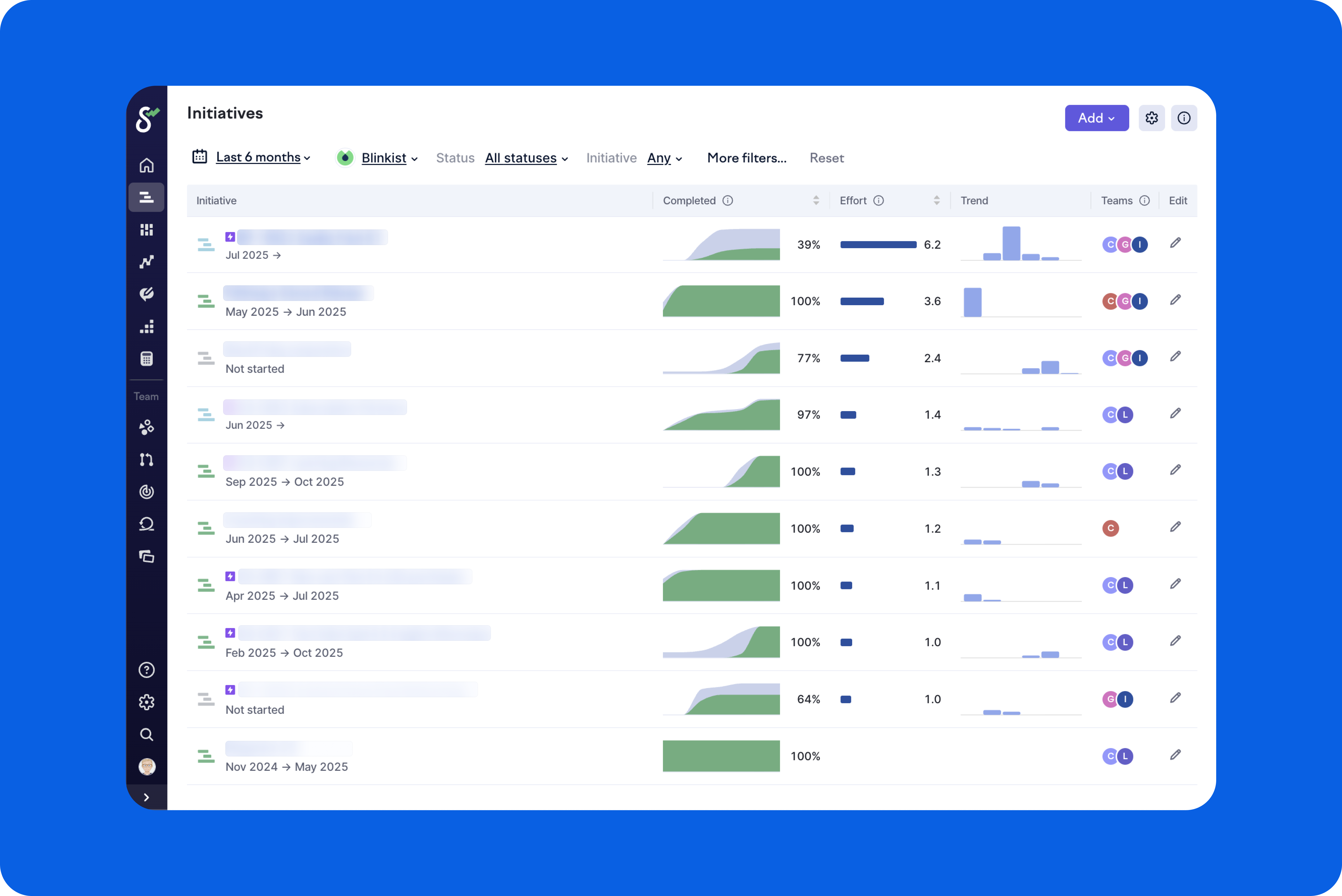
Each initiative in Swarmia automatically surfaces the information Sebastian needs:
- Which teams are contributing and how much time they’re spending on which types of work
- Linked pull requests and issues, so he can see the actual work behind the progress
- Scope changes over time, when new issues get added or work expands beyond the original plan
- Timeline and completion estimates based on actual work patterns
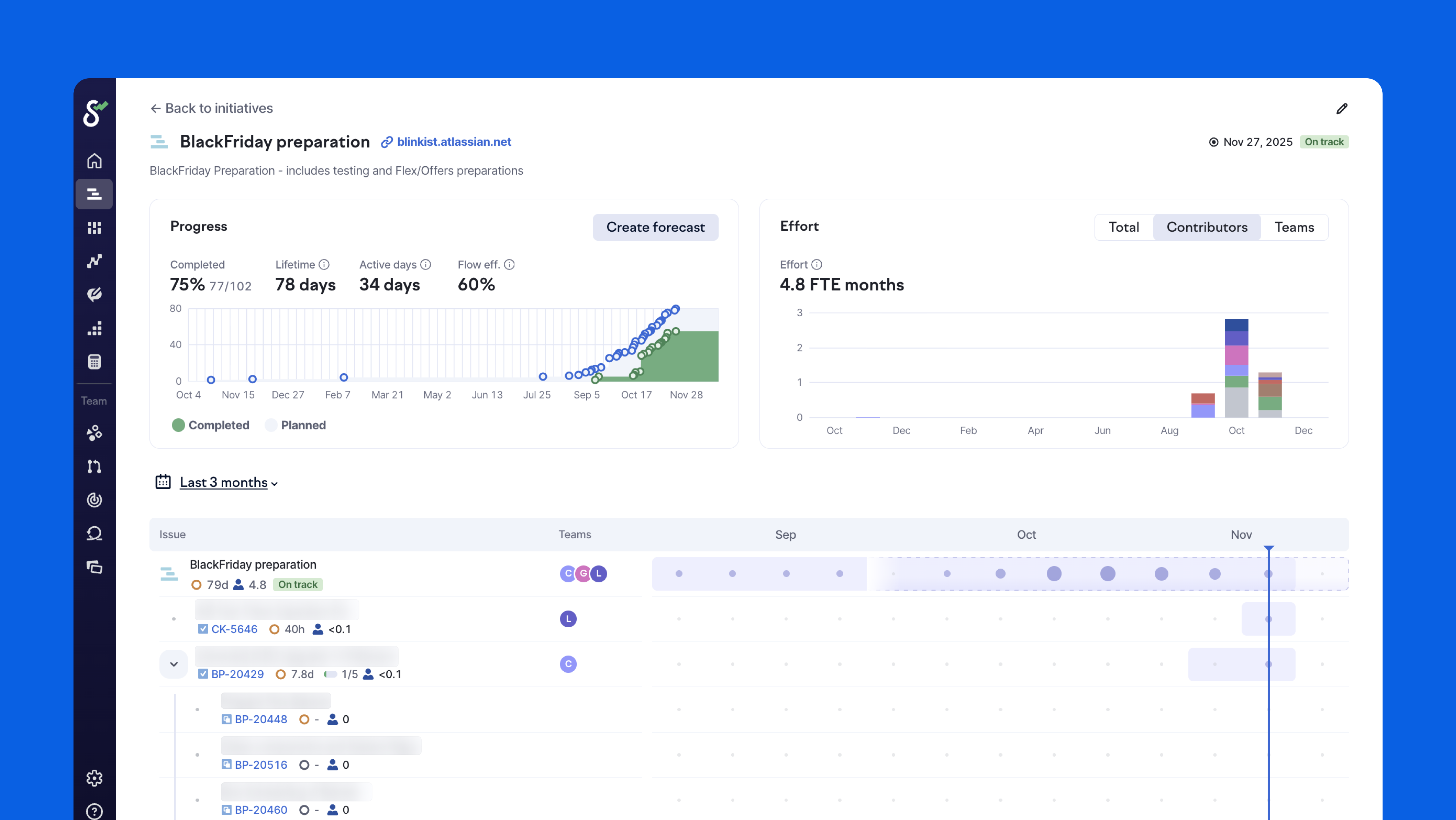
This replaces the process that previously required engineering managers to manually compile status updates. The information is simply there, always current, without anyone needing to update it.
Piecing this work together by hand is like flying a plane without instruments. It works as long as there are no clouds, but it’s risky. Swarmia is one of those instruments for me.
CTO at Blinkist
What engineers actually think
The engineers themselves? They love the Slack notifications that keep work flowing, but otherwise stay focused on doing what they do best — building the best product they can for their customers.
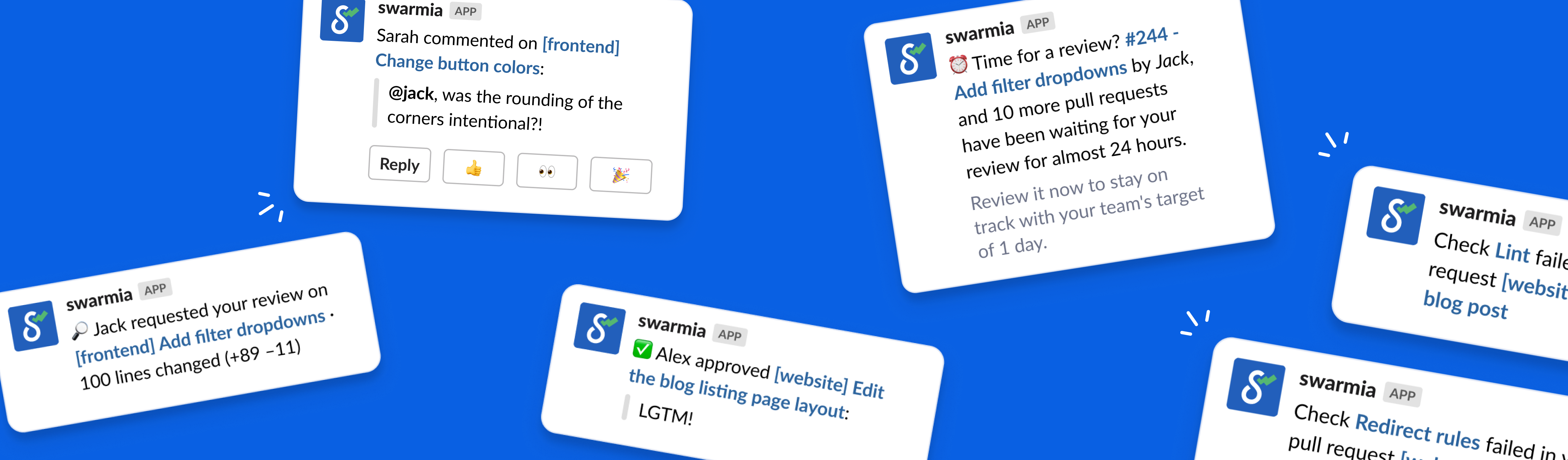
During retrospectives, though, when they step back to understand how they’re working and where to improve, having reliable data makes all the difference.
The IC-led model in practice
Several months in, the experiment is showing promise. Sebastian has the visibility he needs to coordinate his team without creating process bottlenecks. Engineers have high ownership and clear accountability. And leadership finally understands where engineering effort actually goes.
It’s not perfect. Sebastian describes it as “still a journey”, but the model is working. The key has been having the right systems in place to make it viable.
This model won’t work for every organization. But the underlying principle, of making the invisible work of engineering visible, applies just about everywhere.
Swarmia gives me an automated, data-driven perspective on our engineering operations.
CTO at Blinkist
For Blinkist, Swarmia solved that challenge. And it did so without adding overhead, without requiring engineers to change how they work, and without giving leadership a tool they could misuse for performance management.

